
Technical catalogue · Rivets

Rivets

Industrial rivets: families, materials, standards and technical finder. Compare designs and prepare your enquiry to Dueemme Sidol.

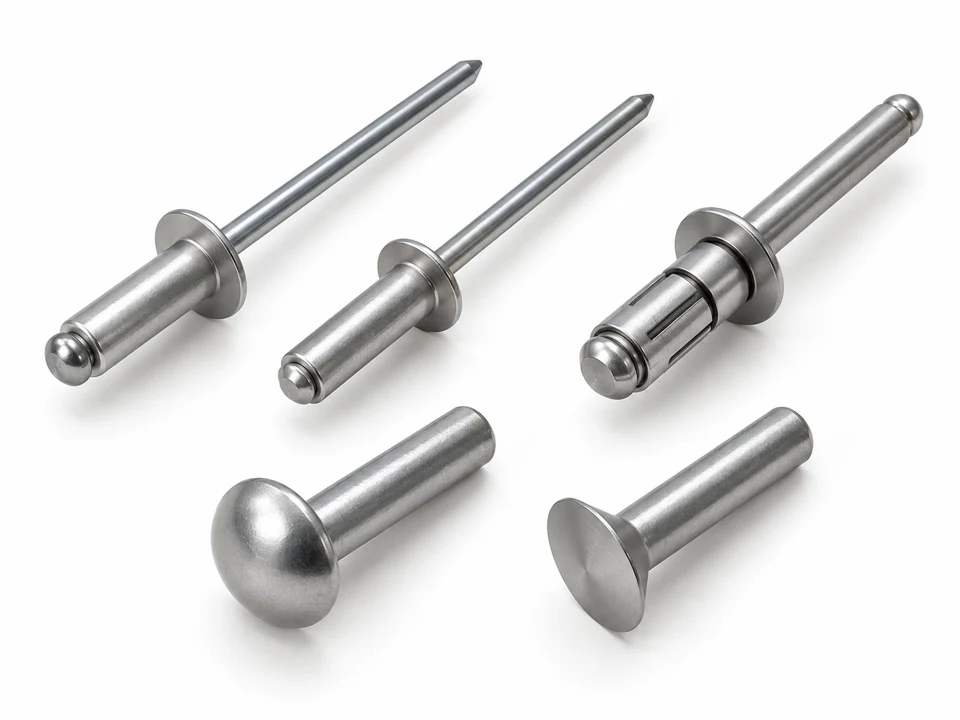
Blind rivets and solid rivets: category image
11technical families
IT / ENbilingual pages
27finder references

Dueemme Sidol S.r.l. is an Italian supplier based in Sesto San Giovanni, Milan. We supply industrial customers and OEMs with screws, bolts, stainless steel fasteners and custom components manufactured to drawing. This section helps specify rivets for permanent joints by access, materials and service conditions.

Find a rivet reference.

Filter families, designs and selected verified dimensional examples. Results support your technical enquiry; size, performance and availability require part-specific confirmation.

Numeric filters return only examples with verified data. Undocumented values are not treated as matches. Results do not constitute a joint design.

Loading references…

Rivet families.

Standard blind rivets

An open body and a break mandrel form the joint from the accessible side. Dome heads suit general assemblies, countersunk heads require a matching seat, and large flanges spread contact on the visible side.

Features and selection →

Speed rivets

Rivets supplied in sequence on a reusable mandrel for repetitive assembly. The setting system and rivet geometry must be assessed as a specific combination.

Features and selection →

From joint to specification.

Information needed to select a rivet.
ParameterRequired information
GeometryDiameter d, length L, head type and envelope; drawing if available.
Grip stackMinimum and maximum total thickness, layer count, materials and coatings.
Hole and accessDiameter and tolerance, through or blind hole, rear access and clearance.
PerformanceShear, tension, vibration, any sealing requirement and operating conditions.
DocumentationStandard with edition, required test report or document and agreed traceability.

Verifiable dimensional examples.

Rivit catalogue examples checked 4 November 2026; each row links to its source.
Identified exampled × L (mm)Head D / k (mm)Hole (mm)Grip (mm)Shear / tension (N)
AFT 0000100.01000 ↗2.4 × 55 / 12.50.8–2.5350 / 500
IITA2 0041900.01000 ↗3.2 × 66.7 / 1.33.31–31800 / 2500
SRFT 008950S.00010 ↗3.2 × 6.5— / ——0.5–2— / —
GORIV 0094300.01000 ↗4 × 88 / 1.34.1maximum 4850 / 1200

Values apply only to the listed part numbers. Loads are catalogue figures, not allowable design loads. Ordering requires technical confirmation, drawing and availability. “—” means no value is reported.

Frequently asked questions.

How do I choose rivet length?

Measure the stack and select a part whose minimum–maximum grip includes that thickness. Body length and grip are different dimensions.

What hole diameter is required?

Use the diameter and tolerance in the individual part specification. There is no universal allowance across families; check burrs, ovality and alignment.

Is a stainless rivet always suitable for marine use?

Check body and mandrel alloy, exposure, chlorides and joined materials. The words stainless or A4 do not qualify the complete joint.

How can I request a quotation and technical documents?

Send the family or code, dimensions, grip, materials, quantity and documentation requirements. Dueemme Sidol checks the specification and availability before confirmation.

Prepare your technical enquiry.

Complete the specification: the summary will transfer to the company form, where you can add your contact details and attachments. Nothing is sent from this page.

Sources and further reading.

Original Dueemme Sidol editorial content. Classification checked against public Rivit pages; standards cross-checked with ISO and DIN Media. Series names identify their owners’ technical references and do not imply authorised distribution.

Editorial verification: 4 November 2026. Specification, documentation and availability subject to quotation confirmation.

Dueemme Sidol
Privacy Overview

This website uses cookies so that we can provide you with the best user experience possible. Cookie information is stored in your browser and performs functions such as recognising you when you return to our website and helping our team to understand which sections of the website you find most interesting and useful.