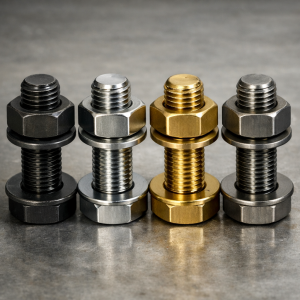
This fastener materials guide provides a technical comparison of the most common materials used in industrial applications, including carbon steel, stainless steel, alloy steel, brass and duplex grades.
The table below helps engineers and buyers select the most suitable material based on mechanical properties, corrosion resistance and application environment.
Fastener materials, grades and property classes differ by standard, composition and intended service conditions. This table provides a technical comparison for reference only and does not imply direct interchangeability between ASTM, SAE, ISO and special alloys.
| Grade / Class / Material Family | Standard | Material | Type | Strength Level | Yield (MPa) | Tensile (MPa) | Temperature Range | Corrosion Resistance | Applications |
|---|---|---|---|---|---|---|---|---|---|
| Grade 1 | SAE | Carbon steel | Low carbon | Low | 248 | 413 | Standard | Low | General |
| A307 A/B | ASTM | Carbon steel | Low carbon | Low | - | 413 | Standard | Low | General, industrial |
| Grade 2 | SAE | Carbon steel | Medium carbon | Medium | 248–393 | 413–510 | Standard | Low | Industrial |
| Grade 5 | SAE | Alloy steel | Heat treated | Medium-high | 635 | 830 | Medium | Low | Industrial, machinery |
| Grade 8 | SAE | Alloy steel | Heat treated | High | 940 | 1040 | Medium | Low | High load, industrial |
| B7 | ASTM | Alloy steel | Quenched & tempered | High | ≥720 | ≥860 | High | Low | Pressure, flanges, oil & gas |
| B16 | ASTM | Alloy steel | Quenched & tempered | High | ≥724 | ≥860 | Very high | Low | High temperature, pressure |
| B8 | ASTM | Stainless 304 | Austenitic | Medium | 207 | 517 | Medium | Good | General corrosion, chemical |
| B8M | ASTM | Stainless 316 | Austenitic | Medium | 207 | 517 | Medium | High | Marine, chemical |
| A325 | ASTM | Alloy steel | Structural | High | 660 | 830 | Standard | Low | Structural |
| A490 | ASTM | Alloy steel | Structural | Very high | 940 | 1040 | Standard | Low | Heavy structural |
| L7 | ASTM | Alloy steel | Quenched & tempered | High | ≥720 | ≥860 | Low temperature | Low | Low temperature, cryogenic |
| L43 | ASTM | Alloy steel | Quenched & tempered | High | ≥720 | ≥860 | Low temperature | Low | Low temperature |
| 8.8 | ISO | Carbon steel | Property class | Medium | 640 | 800 | Standard | Low | Structural, industrial |
| 10.9 | ISO | Alloy steel | Property class | High | 900 | 1000 | Medium | Low | High load, industrial |
| 12.9 | ISO | Alloy steel | Property class | Very high | 1080 | 1200 | Medium | Low | Critical load, industrial |
| A2-70 | ISO | Stainless 304 | Austenitic | Medium | 450 | 700 | Medium | Good | General corrosion |
| A4-80 | ISO | Stainless 316 | Austenitic | Medium-high | 600 | 800 | Medium | High | Marine |
| Duplex | EN / Special | Duplex steel | Austenitic/Ferritic | High | 450–550 | 700–800 | Medium | Very high | Offshore, marine, chemical |
| Super Duplex | EN / Special | Super duplex | Advanced duplex | Very high | 550–700 | 800–950 | Medium | Excellent | Oil & gas, offshore |
| Brass | Special | CuZn | Non-ferrous | Low | - | 300 | Low | Good | Electrical |
| Inconel | Special | Nickel alloy | High-temperature alloy | High | - | >900 | Very high | Excellent | Aerospace, energy |
Selecting the right fastener materials depends on the application environment, required strength class and corrosion resistance.
Carbon steel fasteners are typically used for structural and mechanical applications, while stainless steel and duplex materials are preferred in marine and corrosive environments.
For complex or custom applications, material selection should be evaluated together with manufacturing process and surface treatment.